

The Early Days of the Lowell Police Court

In 1853 on November 10th, the city of Lowell said goodbye to the first Police Court judge, the Honorable Joseph Locke, with his death in the Chapel Hill area of the City at the age of 81 ½ years. Judge Locke was born in Fitzwilliam, NH in 1772 to Jonathan Locke and Mary Haven of Portsmouth, NH. He graduated Dartmouth College in 1797 and studied law with renowned jurist the Honorable Timothy Bigelow. He was admitted to the bar in 1800 and began a practice in Billerica in 1801. He married Lydia Goodwin, daughter of General Nathaniel Goodwin, of Plymouth, MA. He fathered 8 children, 4 sons and 4 daughters. The sons all preceded him in death and the daughters all survived him.
He lived in Billerica until 1833 where he moved to Lowell, where he resided until his death. He was elected 8 times to serve as a member of the state legislature from Billerica and once from Lowell. Was the president of the Court of Sessions for 8 years and was an elector of the president of the United State in 1816 where Monroe won. He was also a member of the governor’s council in 1821 & 1822.
He is best known in Lowell for being the first justice to serve for the Lowell Police Court. He was known to be a staunch supporter of the public schools and religious institutions. He was also noted as being a member of the temperance movement stating “I shall not conform to the custom of treating my constituents to intoxicating liquor, as I do not approve of it; but to convenience you that it is not to save the few small grains of gold the liquor would cost, I will give the amount usually expended on such occasions, for the purchase of school-books for poor children.” [i]
It was documented that Judge Locke was a scholar, with studies in the Bible, Shakespeare, English authors, and common law. He was a fair and firm judge and ensured that the law was followed. In the early years of the police court, naturalizations occurred for immigrants with the judge with the judge believing that “the admission of men to citizenship was the highest duty to his judicial office.” [ii] Around 1843, the Justice of the Court of Common Pleas ruled that the letters of naturalization issued by the Lowell Police Court were worthless. He was told that he would be liable for all of the fees for every man who received naturalization papers and the mayor struck their names from the list of voters. He and his attorney, the Honorable John A. Knowles appealed not once, but twice to Judge Shaw and the Supreme Judicial Court to overturn this ruling and reinstate the naturalization status of all the men. Between 1838 and 1853, there were 959 naturalizations in the Lowell Police Court, of which 826 were Irish and the remaining were primarily English and Scots. [iii]
What was the Lowell Police Court? The first Police Court in the Commonwealth was established in 1821 in Boston, with Salem following in 1831. Lowell and Newburyport were both established in 1833. This was presented and then passed in Chapter 64 of the Acts of 1833. Initially advertisements were presented in Lowell papers, like this one in the Lowell Mercury on Friday, January 18, 1833, specifically naming Kirk Boott in the request:

At a town meeting held on the Monday after this notice, the town agreed to petition the legislature for a police court. This request appeared in front of the legislature on Friday, January 25th. Various bills were presented in the month of March 1833 to establish the court. It was announced on April 4th that the court would be in session shortly thereafter.

“The first session of the Lowell police court was held on April 2, 1833. Number 1 in the criminal docket was Timothy Hoyt (Hoitt) vs. Simeon Hardy, for assault and battery. The defendant pleaded guilty and was fined one dollar and costs.”[i]Number 1 in the civil docket was “that of Phillip T. White, of Lowell, plaintiff, against Joseph G. Morse, defendant. The writ was dated April 1, 1833, and made returnable April 9, an action for debt for services performed by the plaintiff for the defendant, in making divers articles of clothing, the claim amounting to $10.04.”[ii]
In the earliest years of the police court, there was no local jail and prisoners were sent to Concord or Cambridge. Walter Hickey provided additional information after this blog was posted regarding the first jail – The Lowell jail opened in 1837,and closed in 1858 with the construction of the new jail on Thorndike street.
The police court on Market Street used court rooms for both civil and criminal cases, but as Lowell continued to grow the county sold its interest in the court house to the city. In 1849, a new courthouse was build on Chapel Hill.
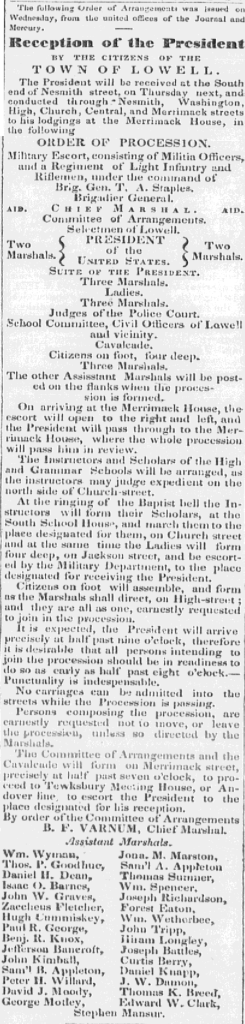
The court was a source of pride in Lowell, with the judges serving in a procession welcoming President Andrew Jackson during his visit to Lowell.
Some of the biggest issues related to the police court that were found in the papers were city ordinances related to liquor and the keeping of dogs. In later years, many instances were posted in the papers. Local historian Walter Hickey through his local history website compiled a number of arrests circa 1860 and gives a listing of what was found in the paper that was held before the Lowell Police Court. An example of one such listing is at http://www.lowellmagenealogy.com/uploads/9/8/9/4/98941312/police_court___ccp_1861.pdf.
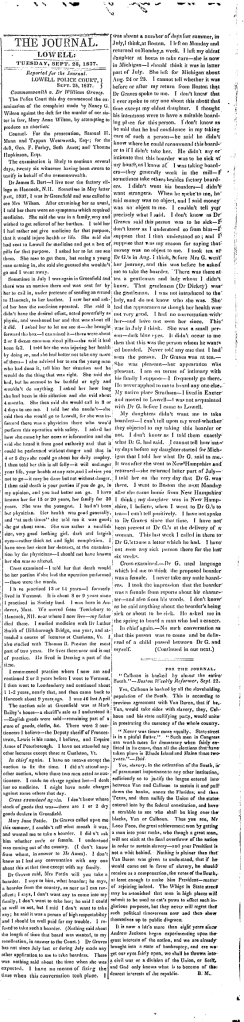
One of the most sensational articles that staff was able to find about the Lowell Police Court was a murder trial in 1837. The Commonwealth vs. Dr. William Graves was undertaken for an alleged botched abortion. While there is a formal document outlining the trial transcript called The Examination of Dr. William Graves: Before the Lowell Police Court, from Sept. 25 to Sept. 29, 1837, for the Murder of Mary Anne Wilson, of Greenfield, N.H. by Attempting to Produce an Abortion, the library doesn’t have a copy. At present, there is no found copy of the transcript in the other local history institutions; however, the Lowell Journal put a good amount of the trial in the paper (Click on the image to open a PDF of the trial transcript in the Lowell Journal.
If you want to learn more about the history of the building that housed the Lowell Police Court in the earliest years through more recent times, access the Massachusetts Cultural Resource Inventory System’s documentation either online or here.
[i] Life and Character of Hon. Joseph Lock, by Hon. John A. Knowles. Read May 3, 1872. Contributions of the Old Residents’ Historical Association, Lowell, MA – vol. 1 – Published June 1873 by the Association, Lowell, MA. pp.66
[ii] Ibid, pp. 67.
[iii] Naturalization Records – Lowell Police Court. www.lowellmagenealogy.com – Walter Hickey – accessed October 27, 2023.