

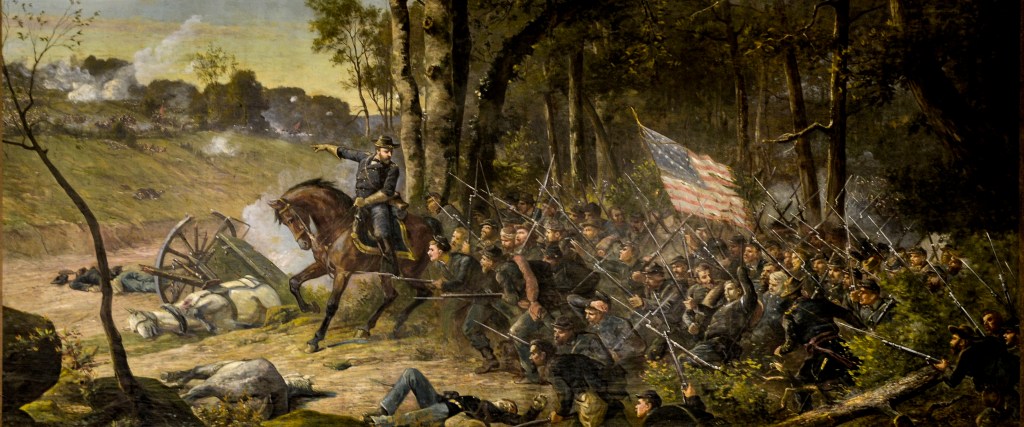
“Battle of Shiloh“, oil on canvas, mounted on plaster 15′ x 25′
“Lee’s Surrender at Appomattox“, oil on canvas, mounted on plaster 15′ x 25′
“Siege of Fort Donelson“, oil on canvas, mounted on plaster 15′ x 25′
Purchased from the Griffin Amusement Company May 10, 1916, these three Civil War murals depict important events in the career of General Ulysses S. Grant. Paul Philippoteaux, a Frenchborn artist, is best known for his painting of the Cyclorama of Gettysburg displayed at the Gettysburg National Battlefield Museum. The artist includes a self-portrait in each of the three paintings. Look for the figure with red hair.
Siege of Fort Donelson
On February 16, 1862, General Ulysses S. Grant captured Fort Donelson, a Confederate-held position in Tennessee on the Cumberland River. Grant’s victory, along with the February 6 capture of Fort Henry on the Tennessee River, gave the Union control of Kentucky and western Tennessee and access to northern Alabama.
Grant sits in this winter scene just slightly to the right of center; it’s the American flag that gets centerstage. Philippoteaux employs several artistic techniques to making sure a viewer’s eyes gravitate toward the flag. The artist used white space around the flag and brighter colors than anywhere else in the painting. There’s much movement in the image. Canons billowing smoke, staff members reigning in horses, wounded soldiers milling about fires. Two men, one of the black in a bright red shirt, also designed to attract attention, carry a casualty to the rear in the lower-right corner. Even the flag looks like it’s about to flap in the breeze.

Battle of Shiloh
On April 7, 1862, the Civil War’s Battle of Shiloh ended with a Union victory over Confederate forces in Pittsburg Landing, Tennessee. The two-day conflict was at that point the bloodiest battle in American history, with more than 23,000 dead and wounded. Grant is shown on horseback, but his pose is active. He’s pointing the way forward for his men, who literally materialize out of the forest on the right side of the painting toward an open area, filled with far-off Confederates, on the left.
Lee’s Surrender at Appomattox
On April 9, 1865, Lt. General Ulysses S. Grant accepted the surrender of General Robert E. Lee and his army of Northern Virginia. This momentous event took place at the village of Appomattox Court House, Virginia, three miles from the present-day Appomattox, in the parlor of the McLean House. Philippoteaux’s mural is a marvelously romanticized depiction of the surrender with far more Confederates present than were actually in the room. Grant and Lee are sitting at a desk at the center of the painting. While the Confederate general had worn his best outfit for the ceremony, General Grant wore muddy boots and looked like he had slept in his clothes.

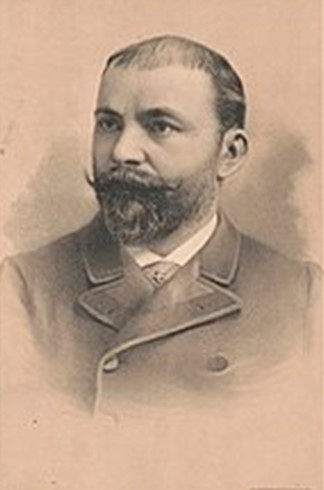
Paul Philippoteaux was born in Paris, the son of the French artist Henri Emmanuel Felix Philippoteaux. His studied at the College Henri-IV, the Ecole des Beaux-Arts in Paris, and under the tutelage of his father, Leon Cogniet, and Alexander Cabanal. His interest in cycloramas and large scale pieces was sparked when he created with his father The Defense of the Fort d’Issy in 1871.
In 1879, he was commissioned by a ground of Chicago investors to create the Gettysburg cyclorama. One of these investors was Charles Willoughby who initially became successful in business in Lowell and then moved to Chicago to continue his success. The Willoughby family are buried in Lowell Cemetery. Philippoteaux spent several weeks in April 1882 at Gettysburg and sketched and photographed the scene. The first cyclorama was shown in Chicago and was so wildly successful, that additional versions were made for Boston, Philadelphia and New York. The one that is on display in Gettysburg is actually the Boston Version. Because of the success of the cycloramas, Willoughby enjoyed the creation of these canvases, which were commissioned by the American Diorama Company – it is estimated that originally there were approximately 30 canvases illustrating the life of President/General Ulysses S. Grant and took 2 years to complete. Each canvas was 30 x 24 feet in size. Philippoteaux was paid $100,000 (about $3.2 million) in 1887 to paint these oversized canvases. These canvases were painted in Philadelphia, in a building specifically for this purpose and then transported via train at a cost of $20,000 to be erected in the Old South Church, where it opened on January 31, 1888. Colonel Frank A. Burr wrote a lecture to be delivered in connection with these paintings. After the special presentations in Boston, and then as part of a travelling exhibit, the pieces were on display at various department stores, the Food Fair at Mechanics Hall in Lowell 1908, the Lowell Armory in 1911, and eventually displayed at the Hathaway Theater (at Shattuck and Market Streets).
After the fire in 1915, the Lowell Art Association went to view the pieces at the Hathaway and eventually purchased the 3 canvases seen today from the Griffin Amusement Company on May 10, 1916 out of 15 offered. Attached to the wall in 1916, they remained in place until the early 1980s when the federal government was looking into finalizing the national park. As such, the city received funds to restore the murals. Cut into strips, the canvases were removed off the wall and restored. Once the walls were renovated, the canvases were reattached.
Because of the scale, Philippoteaux did not sign his paintings, but instead included him in each of the canvases he created. He was also know for adding benefactors, supporters, and other celebrities in the work. We have a few books here about the cyclorama and you can see the variations that he did between the works and who was included or not based on the location it was to be displayed.