

Architect of Memorial Hall, oil on canvas 36″ x 60”

Frederick W. Stickney, architect of the Library, was a Lowell native who studied architecture at the Boston Institute of Technology, not MIT. In 1877, he graduated at the top of his class and received the Boston Society of Architects award for best student work of the year. After graduation, he returned to Lowell to work under a local architect, Otis Merrill. By 1881, he opened his own office in Boston, followed by one in Lowell in 1883. He designed public and private buildings in Chicago, Cincinnati, and New York City. He was the architect for the Moody School and an early building for Lowell High School, which was torn down, Coburn Hall on UMass Lowell’s South Campus, and the Talbot Chapel at Lowell Cemetery. He was a fan of Richardsonian Romanesque, which was named after American architect Henry Hobson Richardson. This revival style incorporates French, Spanish and Italian Romanesque characteristics, including Romanesque arches, short squat columns, recessed entrances, stretches of walling, and more.
His Lowell designs are too numerous to mention but include the Vesper Boathouse (1879, Pawtucket Street), Oliver Cushing House (ca. 1885, 48 Wannalancit Street), Cook & Taylor Building (1884, 231 Central Street), John Howe House (1887, 85 Fairmount Street), Herbert Jefferson House (ca. 1888, 7 Fairmount Street), Pollard Exchange (1891, 55 Middle Street), Moody School (1892, 158 Rogers Street), and Memorial Hall/Pollard Memorial Library (1893, 401 Merrimack Street). With partner William Austin, Stickney designed Lowell High School (1892, Kirk Street) and Lowell Normal School’s Coburn Hall (1897, Broadway Street) on the present-day UMass-Lowell South Campus.
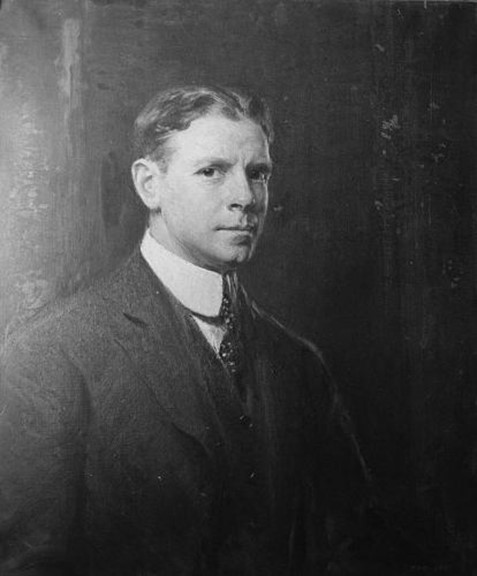
Ernest Ipsen was born in 1869 in Malden, MA, a son of Danish parents. He studied at the Museum of Fine Arts, Boston, from 1884-1887. He continued his training at the Royal Danish Academy of Fine Arts from 1887-1891. After his time studying in Copenhagen, Ipsen returned to Boston and established a studio in the Harcourt Studio building, where he remained from 1900-1904. Eventually moving to New York, he established a studio on 19th street and would continue to work out of the National Arts Club Studio until 1934. He returned to Massachusetts, where he lived in South Dartmouth until the death of his wife. He then settled in Florida until his death in 1951.
Donated by Mr. Stickney, 1918