

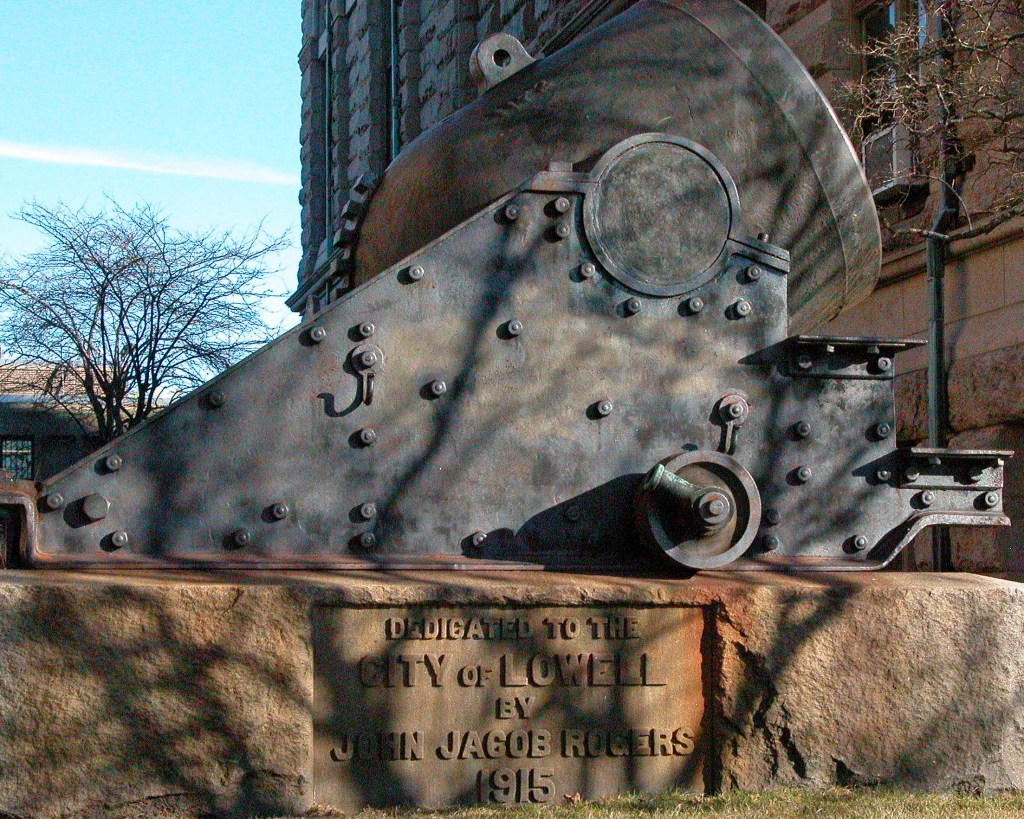
This mortar was formally dedicated to and accepted by the City of Lowell from John Jacob Rogers December 1915 – it arrived in the city in the fall of 1914 and was kept on North Common “resting on a lot of rotten wood” – it was also a fun plaything for children “who may be seen any day climbing up on it and playing around it, any and all of them in danger of death should the underpinnings collapse” [Spellbinder Column – Lowell Sun – October 9, 1915 – front page]. As part of the aftermath of the fire of Memorial Hall and the rest of the library, discussions were held to mount this mortar and the gun that formerly resided in Memorial Hall be mounted onto granite bases. Originally the idea was to obtain an old gun or cannon from the Revolutionary War to complete the trifecta of military artillery. “Congressman Rogers volunteered to pay all of the expense connected with the mortar, including the cement base, granite base and the moving of the mortar from the North Common.” – Lowell Sun, December 24, 1915 – granite base is estimated at 10 tons.

John Jacob Rogers was an American lawyer and politician who served seven terms as a member of the United States House of Representatives from Massachusetts from 1913 until his death in office in 1925. His wife, Edith Nourse Rogers, succeeded him in Congress and served for 35 years. Born in Lowell, he graduated from Harvard Law School and practiced law in Lowell around 1908. He served in local government as both a member of the city council and a school commissioner. During the Great War (World War I), he enlisted as a private and was honorably discharged in 1918. He is best remembered as the “Father of the Foreign Service” for his sponsorship of the 1924 Foreign Service Act, also known as the Rogers Act. He died of appendicitis during his last term on March 28, 1925 and is interred at Lowell Cemetery.